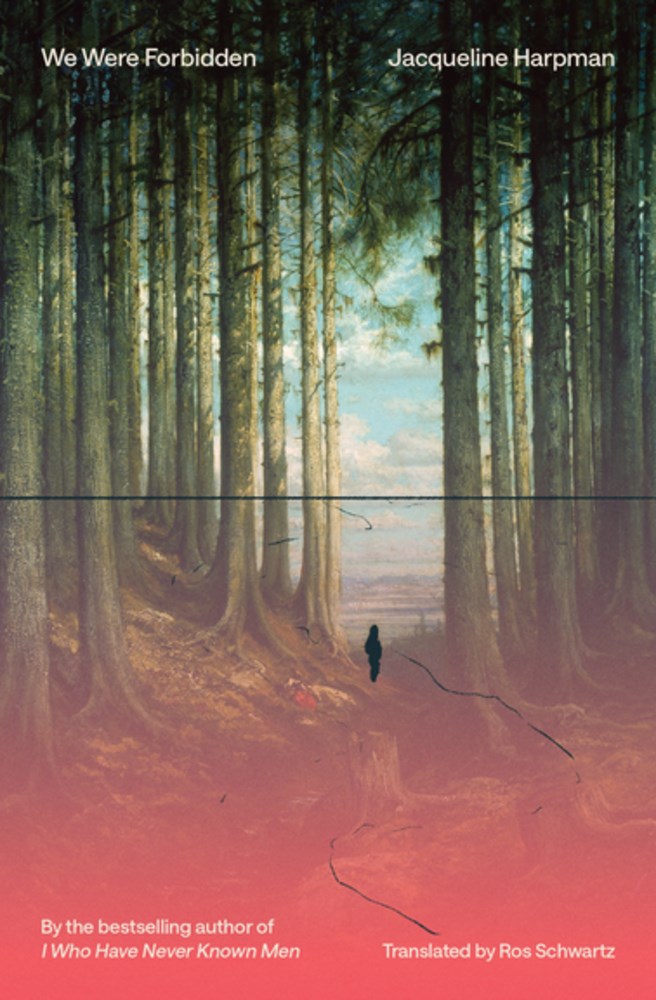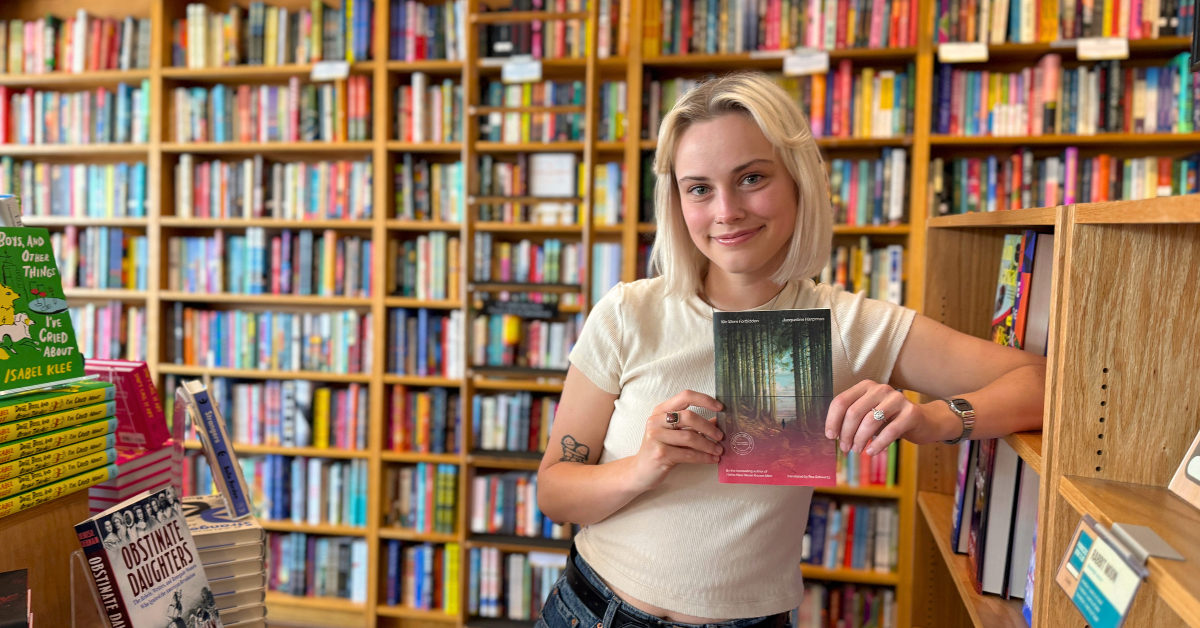
If you’ve been on the bookish side of the internet at any point in the last several years, chances are you’ve heard of I Who Have Never Known Men by the late Belgian author Jacqueline Harpman. Maybe it was our own bookseller Hannah who introduced you to the book in a New to You video last year. It became an unexpected hit after it was reissued in 2022, due in no small part to the work of the brilliant translator Ros Schwartz. Hannah was lucky enough to ask Ros some questions about the translation process and her connection to Harpman’s work ahead of the release of Ros’s newest Harpman translation, We Were Forbidden. Enjoy their chat!
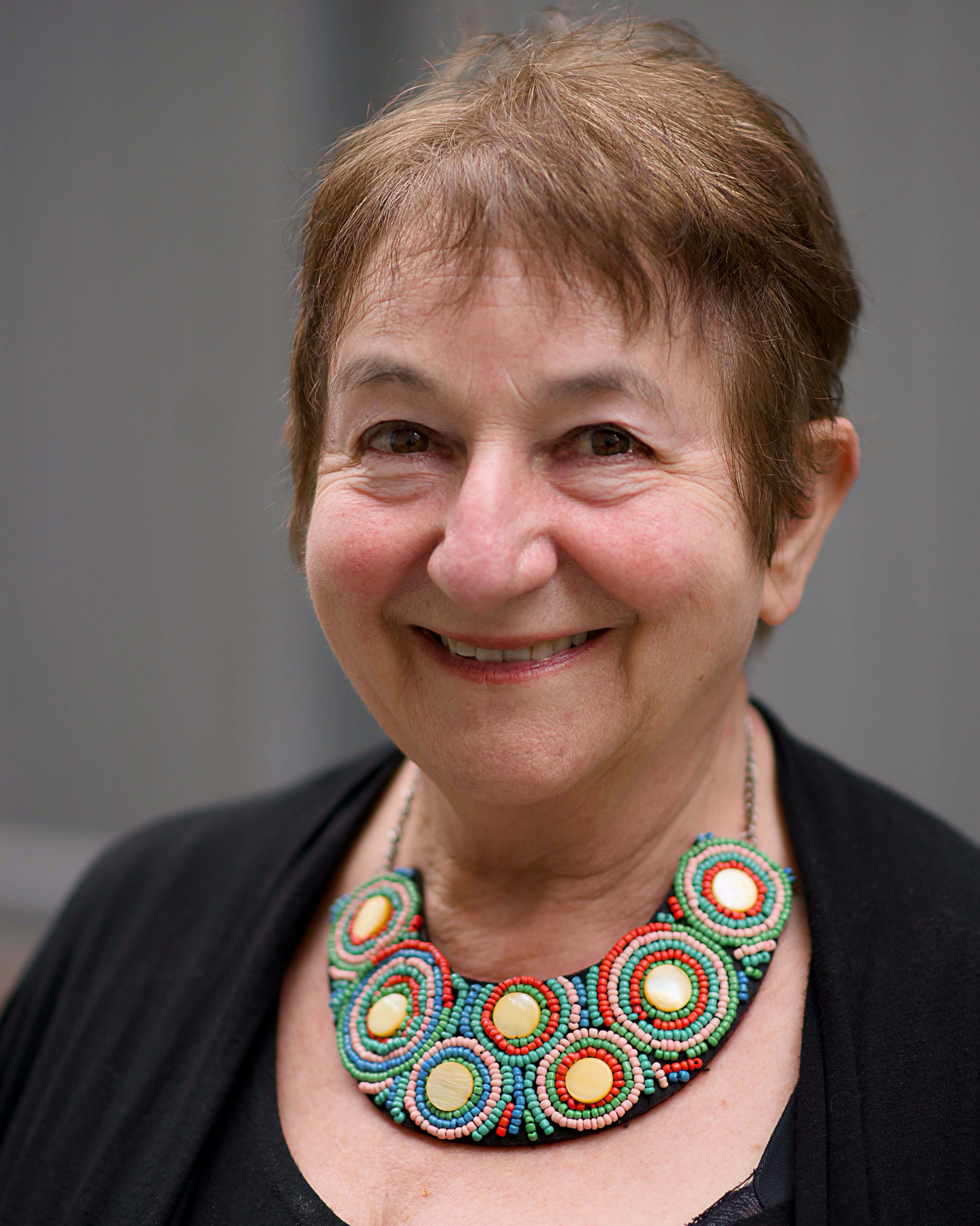
Hannah Peterson: Your journey to becoming a translator was an adventurous one! You grew up hearing Yiddish from your grandparents and French from your parents, while picking up other languages that surrounded you. After leaving university and working several miscellaneous jobs in France (from vineyards to goat farms), you returned to 1980s England and found yourself “unemployable.” Thus, with your skill for multilingualism under your belt, you launched yourself as a translator. Aside from a successful and award-winning career, what other doors has translation opened for you?
Ros Schwartz: The translation community is international and supportive. I’ve been involved in translator associations for many years and was chair of CEATL, the European Council of Literary Translators Associations, which has given me a vast network of translator friends around the globe. From my practice, I have developed translator training initiatives and am co-director of Oxford Translates online literary translation summer school. I have led workshops around the world, in Delhi, Jaipur, Hyderabad, Vilnius, France, Canada, Holland, Sweden, Italy… and spoken at conferences and on the radio. It’s wonderful to combine traveling for professional reasons with visiting different places and meeting my ‘tribe’. I’ve gained new skills along the way: tutoring, public speaking, event organizing, negotiating skills.
HP: I’m so curious about the methodology of translating a book. Do you first read through an entire text in its original language to gain familiarity before translating, or is the work of translation already happening during your first read?
RS: I read through the entire book to ensure that it’s right for me and to get a measure of the challenges that await me. During that first read, the text starts to percolate through me and I mull over some of the questions it raises, mainly when I’m not at my desk, when I’m swimming or cooking. It’s very important to feel empathy with the work, and if that’s not there, I won’t do a good job and the translation process will feel like a chore. That’s something I learned the hard way.
HP: I’m in awe trying to imagine how a translator balances conveying prose, tone, spirit, and mot juste all at once. How much of translation is a creative act versus a literal one?
RS: Translation is a creative act, period. It’s a constant juggling act, striking a balance between meaning and music, trying to ventriloquize the author in English, capturing the essential energy of the original, translating the emotions and atmospheres beneath the words. And sometimes you have to make creative leaps to do that. It’s not about substituting words in one language for another. Let me give you a concrete example from Jacqueline Harpman’s Orlanda: At one point, the literature professor Aline Berger, who’s in an ambiguous relationship with the rock journalist Lucien Lefrène, aka Orlanda, inadvertently slips from the formal ‘vous’ to the informal ‘tu’ in French. And he immediately picks up on this Freudian slip. English has no equivalent as we only have the one word: ‘you’. So I needed to find a cultural equivalent. I had her inadvertently put her hand on his arm, which translates the same shift in her attitude towards him as the French verbal slip. The act of translation is like doing a Rubik’s Cube. You make one adjustment and that affects something else—you’re constantly twisting and turning and tweaking to make all the components work together.
HP: Your first translation of Jacqueline Harpman’s work was I Who Have Never Known Men in 1997, followed by Orlanda in 1999 and now We Were Forbidden. What first drew you to Harpman’s work, or who reached out to you to take on these translations?
RS: It was quite simply the publisher, Harvill, back in the 1990s who commissioned me to translate Harpman. At that time, the books sank without trace. Then in 2019/20, Vintage Classics, who’d acquired Harvill in the meantime, approached me and said they wanted to re-issue the books. I asked to be given the opportunity to revise my earlier translations, which were the work of a rookie translator, and it is my new translations that have been published and achieved global success.
HP: When translating I Who Have Never Known Men in 1997, how much communication (if any) did you have with Jacqueline Harpman? Did you ever consult her for guidance, and similarly, did you consult any historical/biographical resources for Orlanda or We Were Forbidden?
RS: In those days there was no internet. I corresponded with Harpman by snail mail. I asked her a handful of questions to which she replied. I wouldn’t call it guidance but rather clarification. For Orlanda, I re-read relevant passages of Proust and Virginia Woolf, and checked all the literary references. In the 90s, I travelled to Brussels and visited all the places mentioned in the book, because it’s so important to have a sense of the place where a novel is set, to be able to see the streets, hear the sounds, smell the odours, taste the foods. For “The Outcast” in We Were Forbidden, I researched all the historical events against which the story is set.
HP: Part of what excited me so much about We Were Forbidden is its display of Harpman’s brilliant range. Readers are taken from an existential quest of blind obedience, to a young schoolgirl exiled for refusing propaganda, to a lustful imagined sequence that blends the roles of narrator and character. I was also delighted to see much more of Harpman’s wry wit and playful humor here, especially in the second and third novellas. Is there anything else in We Were Forbidden that you think introduces a new angle of Jacqueline Harpman to readers? (And on an unrelated note: Are there any untranslated Harpman works that similarly showcase her writing versatility?)
RS: I’ve read several of Harpman’s other works and while they are extremely different, reflecting as you so rightly say her extraordinary range, there are some themes that are common. In particular, her women are all rebels in their own way, breaking societal taboos, sometimes scandalously (as in “The Broom Cupboard”). I’ve just finished translating the next novel to come out (in 2027): With Total Impunity which again has strong female protagonists flying in the face of conventional morality. I shan’t say more as it would be a spoiler alert. The other feature of Harpman is her love of the French language and of nineteenth-century French literature, which she weaves into her fiction in ingenious ways.
HP: While we see influences of Harpman’s life experiences as a psychoanalyst and as a WWII refugee threaded through many of her works, the second novella “The Outcast” is her first autobiographical piece to be translated into English. In her abundance of untranslated works, what other self-told accounts of her personal history exist?
RS: As far as I know, there is just her 2011 book Ecriture et Psychanalyse where she explores the relationship between her work as a novelist and as a psychoanalyst.
HP: Without revealing too much about the third novella, “The Broom Closet,” there is a spectacularly layered angle that blurs the distinction between author and protagonist. This subject itself was quite a lot to wrap my head around, so I’m wondering how difficult it was to translate. Have you come across any challenges or surprises when translating Jacqueline Harpman, and was this one of them?
RS: You’re right that it was quite hard to untangle the voice of the fictional narrator from that of the author, and to time travel. I had to re-read my translation several times before I ‘got’ what was going on. Harpman often inserts herself into the skin of her narrator (as in Orlanda) and having met her, I can picture her in those personas.
HP: I have heard literary translation be described as “the closest form of reading.” As someone who has read Harpman’s work over and over, is there a dimension of her work that has revealed itself to you slowly over time/over multiple reads?
RS: It’s a rare privilege to translate several books by the same author. As you say, no one reads as closely as a translator. I think being immersed in Harpman’s work for the past 4/5 years has given me an appreciation of just how radical she was.
HP: A shared theme in the We Were Forbidden novellas (and in several of Harpman’s works) is women unlocking their agency and autonomy. In the spirit of Women In Translation Month coming up in August, do you have any thoughts on translation itself serving as a path to accessing and empowering women’s voices, liberties, and selfhood?
RS: Just as women have agency in Harpman’s works, translators can have agency through the books we choose to champion and present to publishers, focusing on untranslated women writers and bringing them into English. I’m especially proud of one book for which I was midwife: Mireille Gansel’s Translation as Transhumance (The Feminist Press). And it is solely thanks to the unstinting efforts of women translators that the works of Olga Tokarczuk (thanks to Jennifer Croft), Han Kang (Deborah Smith) Geetanjali Shree (Daisy Rockwell) and Banu Mushtaq (Deepa Bhasthi), all winners of the prestigious International Prize, have come into being in English, to name but a few.
HP: In the wake of the renewed sweeping success of I Who Have Never Known Men and the high anticipation of We Were Forbidden, what is it about Jacqueline Harpman’s voice that is still striking a chord with readers across generations and around the globe?
RS: I think you will have to ask readers that question! Maybe because Harpman makes us think about what it means to be human? There is something essentially uplifting in the women’s quest for survival and ability to adapt in I Who Have Never Known Men.
HP: Thank you so much for taking time to answer my questions, Ros! To wrap it up, we always like to end with this question: What is your favorite thing about independent bookstores?
RS: Indie bookstores tend to be run by people who are passionate readers and who curate the books they offer. They are knowledgeable and can guide readers to books they might not otherwise pick up. Indie bookstores are the perfect partners for indie publishers and by definition are open to works in translation.
We Were Forbidden will release on July 7, 2026. Pre-order your copy now!