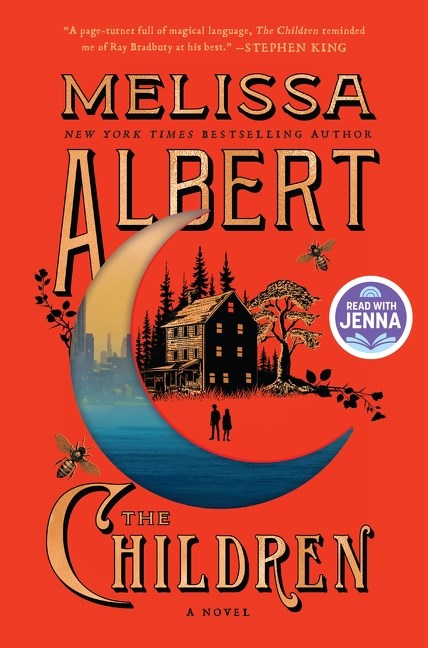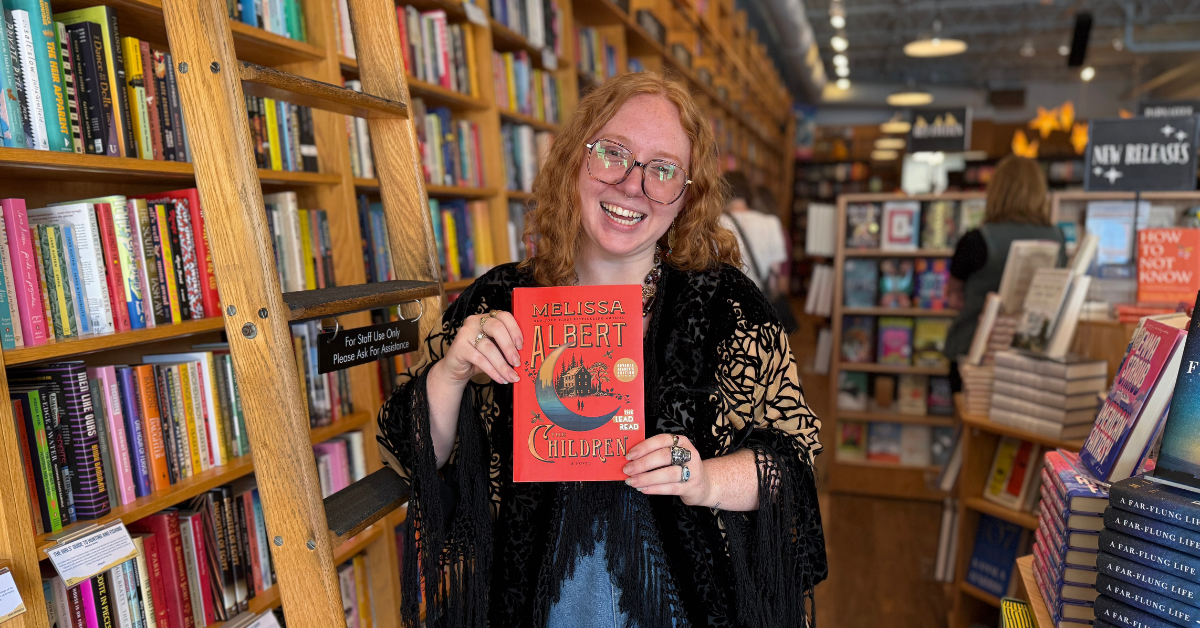
The Children tore me apart! I loved this book so much. Reading it put me in a trance, and genuinely I could not look away until I made it to the end, and even then I couldn’t pull my head from the haunting atmosphere. It is such a genius blend of fantasy, horror, lit fic, and suspense, plus a complicated love letter to children’s literature. It puts all the fun of genre into a perfectly brewed literary package. If any of those elements appeal to you, grab a cup of tea and a copy of this book, and settle in on a stormy night for this otherworldly reading experience.
— Rachel Randolph, Orders Manager
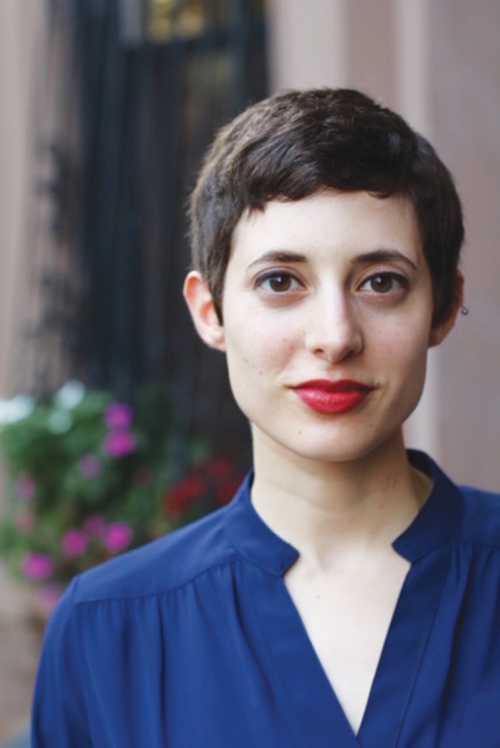
Rachel Randolph: The Children explores the close bond between a brother and sister, described as a “two person cult.” Did you always know the story needed to be told entirely from Guin’s point of view? In the drafting process, did you write any Ennis scenes that did not end up in the novel?
Melissa Albert: I always knew this was Guin’s book. The mystery of Ennis–why they’re estranged, the truth of his art, what exactly happened at the end of their childhood together–is to me the book’s emotional heart. Beyond secret keeping, it felt important to keep the POV very tightly on Guin: first as she makes her slow journey away from innocence as a child, who doesn’t yet comprehend the truth of her parents and the ways her older brother is protecting her, and later as an adult shaped in large part by her brother’s absence.
RR: The scenes at The Farmhouse during the children’s childhood have a mystical blend of whimsical eeriness and the constant threat of danger hiding beneath the idyllic scenery. How do you build consistent tension through the story? Does it require structuring beforehand or do you cast it like a spell?
MA: I like to embed tiny mysteries, unanswered questions, and other oddities into my drafts as I write. Many get revised out later because they serve no purpose, while others end up driving the whole plot. This can feel thrillingly, almost unsettingly random, but it’s the closest I can get to that readerly, “what’ll happen next” feeling as a writer–which keeps me excited and invested in figuring out the book. I think and hope this contributes to creating that sense of interest and tension for the reader.
RR: This book is such a love letter to children’s literature, particularly the stories that hold more darkness upon further examination. Can you talk about your relationship to stories as a child? What books haunt you still?
MA: Peter Pan still haunts me. It’s the only book I read as a child that made me painfully, ineffably nostalgic for my childhood even as I was still inside it. There’s this bit on the first page about the moment a child discovers they must eventually grow up: “You always know after you are two. Two is the beginning of the end.” I felt like reading Peter Pan was a kind of beginning of the end for me. It confirmed not just that I would grow up, but that I would become (shudder) a grownup. It made childhood feel so painfully short and sweet. I make reference to Guin’s father reading the mermaid’s lagoon chapter to her in The Children because…well, I shouldn’t reproduce the whole thing here. But if you’ve got a copy read the first paragraph of chapter eight. It might be my favorite paragraph in children’s literature.
RR: Horror as a genre is growing across age categories. I particularly love seeing it blended with fantasy and magical realism. What would you say to adults who are hesitant to hand young readers dark stories?
MA: I think children are just as fascinated by darkness in storytelling as adults are, if not more. And I do believe adults are more disturbed by certain kinds of darkness, that kids are more likely to see as practical or satisfyingly fair: dark vengeance, ruthless rule keeping. I read lots of books way too early, and it made me a curious, omnivorous reader who never censored my own book choices–and I really only absorbed what I was developmentally capable of absorbing. What I’m trying to do for my own son, who will absolutely encounter media he’s not ready to handle (though I’m way more worried about YouTube garbage and AI slop than anything he might find in a book), is to teach him how to protect himself, that it’s okay to step away if something is too much for you. Having 100% not followed this rule throughout my own childhood–peer pressure is a bitch, I was NOT ready to watch Carrie or Scream–I’m not confident this approach will work. But I’m at least going to try!
RR: How did your experience writing young adult fiction prepare you to write this book? Is this a permanent shift to adult, or do you have more young adult in the works?
MA: I think the most important thing that has moved with me from YA to adult is a reverence for young characters. I’m very interested in how kids metabolize and operate on incomplete information, what they get wrong and what they perceive in an instinctive or wordless way, as well as how their lives are bound up almost entirely in the decisions of other people. There’s so much magic and friction available to a writer just in these table stakes realities of being young. And the category shift feels like a permanent one.
RR: I loved the chapters showcasing Ennis’s art installations. Was it difficult to create these seemingly world altering shows that still functioned logistically in the reader’s mind? Any artists you had in mind while visualizing the paintings in the novel?
MA: I loved creating these shows! I figured there was some fun squidginess in there in terms of: could this exist? Is it artists’ tricks, group hypnosis, actual magic? But yes, I did want to keep it pinned and physical enough that there was a plausible deniability to it, a feeling that everything you’re reading about might in fact be a show you could walk through. I was inspired by a number of things–museum Period Rooms, black box theater in Chicago, immersive shows like Sleep No More. As far as specific painters, I thought a lot about this Mickalene Thomas show that ran at the Brooklyn Museum: gorgeous multimedia portraits and interiors, and in the middle of it one of her painted rooms re-created as a freestanding installation. That doubling, and the desire I had to step inside it, have stuck with me.
RR: The Children toes the line between reality and fantasy on multiple layers. As a reader, I loved the subversion of my genre expectations. I never knew if the events were truly paranormal or if the atmosphere and child’s POV were sweeping me up in invented fantasy until the end (no spoilers!). I loved the dance between grounded literary fiction and horrific fantasy! Were you tempted to cross those genre lines sooner in the novel?
MA: Oh, I love this question. I will say that, as a reader, I’m always a little gutted when a book pulls the Scooby-Doo switcheroo: the ghost was an old dude in a mask all along! But I *do* love an extended period of accruing weirdness, and that moment when all the hints at something weird/supernatural going on tip over into answers that are maybe weirder than you even expected. I’m getting into spoiler territory, so I’ll stop!
RR: Did working as a bookseller change your perspective on writing at all? What did it teach you?
MA: When I worked as a bookseller I had some snobbiness I had to work through. I would’ve recommended Thomas Pynchon to a baby just to prove how cool I was. It was later, working on the content team for Barnes & Noble, that I realized what the true work of a bookseller is: it wasn’t imposing my awesome taste on other people, it was recognizing that every book is going to be someone’s favorite book, and what you’re trying to do is read broadly and matchmake. I try to remember that as my books move out into the world: no book will be everybody’s cup of tea. But if you’re lucky yours will be someone’s favorite cup of tea.
RR: What books or other pieces of media informed this work?
MA: I have to shout out the Chronicles of Narnia, which absolutely changed the course of my life. I also deeply deeply love the Magicians trilogy, which is of course another author’s holler at the Narnia books. I was also thinking about Sally Mann’s troubling, beautiful photographs of her children in a rural setting; the photo of young Guinevere and Ennis that plays a part in this book was very much written with Mann in mind.
RR: And my favorite question to ask: What is your favorite memory from an independent bookstore?
MA: I have so many! Indie bookstores are woven into the fabric of my parenting, my work, my life. But I’ll go way back, to a memory that still makes me laugh. I was working the register at Powell’s books on Lincoln Avenue in Chicago (RIP) when Sonic Youth walked in. (Minus Kim Gordon, sadly.) You can’t see Thurston Moore and not know who you’re looking at, but I grabbed a Chicago Reader just to confirm they were playing in town that night. When he walked back to the counter to buy his books I was clutching the listings, still kinda staring at him quizzically. He locked eyes with me, smiled mysteriously, and gave an extremely slow, pointed nod, as if to say, Yes. It is I, Thurston Moore. I really appreciated the whole wordless interaction.
The Children is on our shelves now!