
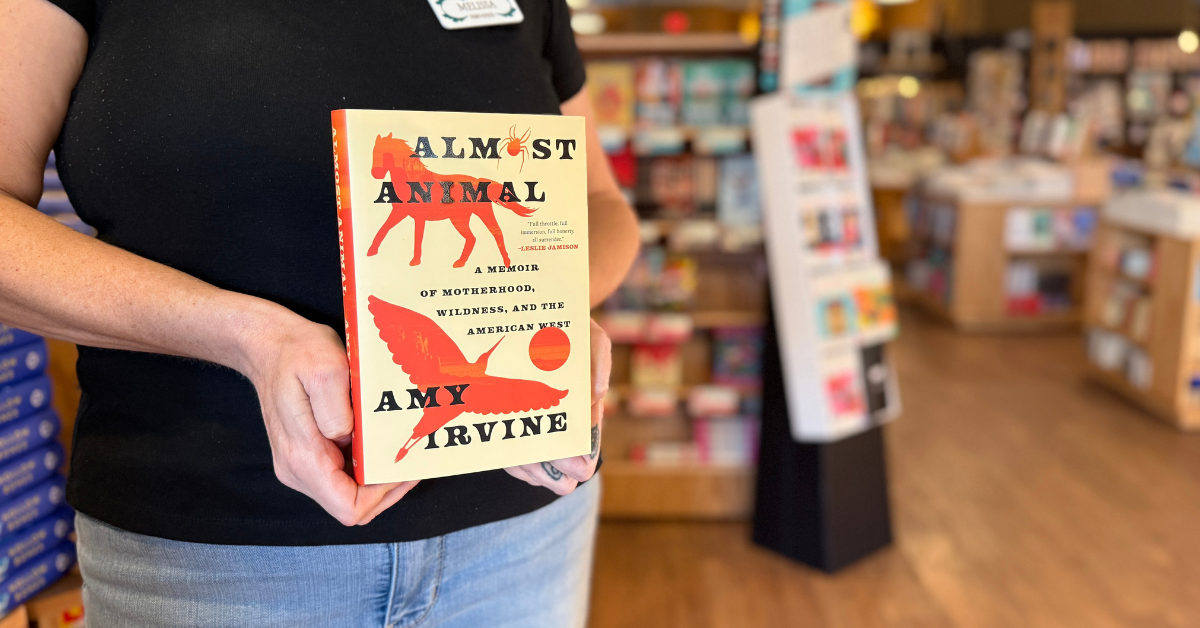
Almost Animal: A Memoir of Motherhood, Wildness, and the American West by Amy Irvine is an incredibly specific book—you’ll learn so much about the natural history of Utah, the history of Mormon women, and land politics of the American West—but the themes of wildness, freedom, love, and having the courage to grapple honestly with complicated legacies will resonate with any reader. I was also raised in Utah, so this memoir hits close to home for me, and I’m delighted to interview Amy Irvine about the themes of the book.
— Melissa Jean, Parnassus bookseller
Note: This interview contains sensitive material that may be distressing to some readers, including references to self-harm and sexual abuse. Please take care while reading.
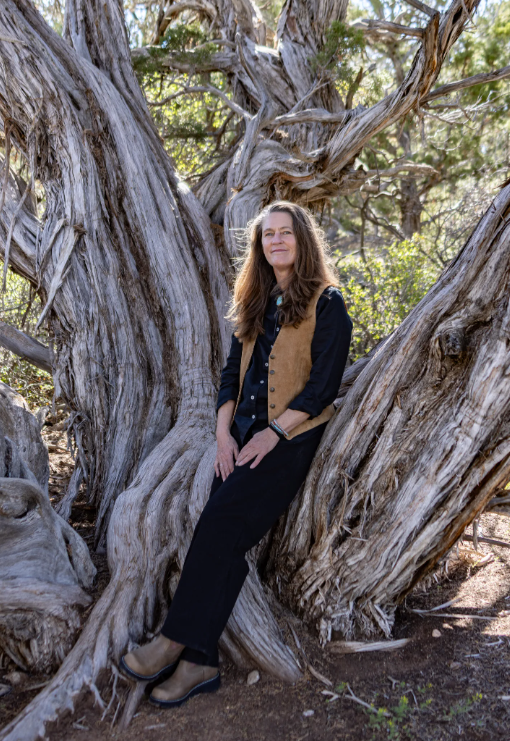
Melissa Jean: Almost Animal feels like an excavation. You’re digging deep into your family history, as a sixth-generation Utahn, and into the history of Utah and Mormonism, and what you uncover is complex and challenging. You write: “Whatever was dismissed or denied would either fester or squeeze out sideways. It was better to unearth the whole hot mess of things—the love and hurt, the care and neglect, the possession and dislocation—and hold all of it, cupped in both hands, up to the light.” Do you ever feel fear when writing about your family history with this unflinching sense of nuance? Why do you think it is so important to do this excavating work?
Amy Irvine: Excavation is exactly the right word, since I had to dig into a history guarded in vaults that sit deep in a mountain of granite! There is a scene in the book where I am parked roadside in a canyon in the Wasatch Mountains, above Salt Lake City, my hometown. I am contemplating driving off the cliff with my mysteriously ill daughter in the backseat; our lives had become completely unsustainable due to two undiagnosed conditions: postpartum depression (mine) and a life-threatening form of epilepsy (my daughter’s). I had sought help, a lot of it, and was met largely by dismissal and medical gaslighting. As in, “You’re just an overanxious mother who needs to calm down.”
I had many formative memories in that canyon—it was where I learned to ski and rock climb and generally hold my own in a culture that seems hellbent on disempowering women. But that day, I realized there was something that literally overshadowed all that I’d overcome: the LDS Church’s archives, the doors of which loomed high on the canyon wall overhead. Nearly seven hundred feet belowground, behind doors built to withstand fire, earthquakes, and nuclear blasts, there are 35 billion images of genealogical information, contained mostly on 2.4 million rolls of microfilm. Something about those massive archives and how closely guarded they are, made me realize that there was much I didn’t know about my ancestors, and their part in “how the West was won.” Just considering this was enough for me to turn the car around and drive to the hospital, to once again try to seek help. Because I understood that day that maybe the feelings of worthlessness and entrapment I felt as a new mother were not only my own feelings, but those of the generations of mothers who came before.
When I began to dig into the thornier aspects of Mormon occupation of the West, I learned that my family was in fact part of, or adjacent to, certain atrocities. I lived in terror during the years I wrote and researched, because it felt so taboo to be digging into what people refused to discuss. But the truth is that, in the first fifty years that my people occupied Utah, the then-territory lost more than 80% of its Native people. In continuing to ignore, silence or erase that history, everyone, both the colonized as well as the colonizers, continue to be haunted and harmed by generational trauma. And this is the thing I do not fear: the collective repair process that would bring such peace and healing.
MJ: The natural world is so vividly present throughout Almost Animal; the narrative is populated by plants and creatures and living rivers. How can a strong sense of relationship with the natural world anchor us when we are grappling with difficult histories?
AI: The mothers in my family are by and large not the nurturing type—thanks to a lineage of suffering and scarcity (I descend from “low-ranking” Mormon plural wives who lived mostly alone in earthen dugouts with very few resources—living almost as animals). So I turned to the natural world early on, as a place to seek refuge, a place to belong. It is being held by and connected to something larger than oneself, and feeling a kinship to a place that sustains us, that allows us to unearth the stories that are buried there, hold them up to the light, and do the forensic analysis that asks: What really happened here?
We’ve lived with the misguided perception that home is where the heart is, but I’d say it’s where the bones are. And the ghosts, too. The fear has been that, if we dig beneath the surface, we’ll be exiled from the only place we feel rooted to because we are not indigenous to it. That underlying fear and anxiety now eats away at the whole of America, and what I want this book to show is that the process of facing into that history has far more benefits than consequences. We have everything to gain by reckoning with the past. Not the least of which is our own healing.
MJ: I love your stories about motherhood—and particularly about mothering close to the land—as you lose and find yourself over and over again. How do you think your initial notions about motherhood were constructed by your cultural background, and how has your relationship with nature helped you un-settle those notions and discover something more authentic about mothering?
AI: All my life I have bucked against cultural norms for motherhood; in no universe would I be as confined to the home front as my maternal forebears had been! Whether it was epigenetic memory or cultural conditioning that triggered the trend, I found myself living in eerily similar conditions. No longer was I a park ranger, or a rock climber or a wildlands firefighter. No longer was I even writing. Instead, I was stuck at home alone with a sick child who needed all my attention and a barnyard full of domestic animals. It wasn’t until a neighboring rancher put me on a horse to help with a cattle drive, during which I had a close-up encounter with a mountain lion, that I realized that I needed re-wilding as much as the land did. And that a less constrained version of me would be a far better role model for my daughter.
At the same time, I was realizing what a myriad of studies have rightly concluded: women, especially mothers, do far more than their fair share of unpaid domestic and emotional labor. In other words, no one needs mothering more than mothers, and guess who will mother you endlessly? Mother Earth. It was putting myself in her care, connecting with wild places and all the wild species there, that healed me from what I liken to zoochosis, the madness of a wild animal when caught and caged.
MJ: As you tell the stories of your Mormon women ancestors and grapple with the impact of Mormon patriarchy on your personal life—even your post-Mormon personal life—you note that “some part of me had never fully entered any house because I feared I’d never be able to leave.” How do you balance your appreciation for the stories of women in your family line with your choice to find a new way to tell the old stories and choose the life that you want for yourself?
AI: There is a scene in Almost Animal in which I catch a glimpse of myself trying to exit the goat pen, milk pail in one hand and freshly gathered eggs in the other, with an ailing, miserable child on my hip. I’m slipping around in the mud and manure, while my husband is at the gym pumping iron. I look out at all the millions of acres of wildlands in every direction—the home of my heart—and I realize how deeply conditioned we are to repeat the past and to fulfill roles that we ourselves did not define. What a moment that was. Like the distant past literally caught up with me. Either that or I was on the verge of becoming one of those trad wife influencers who are so popular now—and it’s no surprise that many are from Utah. If only they truly understood how rough my, our, female ancestors had it.
The antidote to my need to flee all things domestic was to, say, put my daughter in a backpack and take off into the wilderness on foot. There’s a scene in which we entered a clearing where dozens of elk were bedded down, and the great beasts rose silently and began to circle us. I turned in a circle too, amazed that we weren’t getting trampled. Instead, we were being gathered, folded into an entire herd of mostly mothers and calves. It was an intimate, and electric moment in which I felt such interdependence with the animals, and with my child, too. And honestly, when the herd broke and headed south, I wanted to run with them. I felt then, the gratitude for the intrepid nature of my pioneering foremothers. Their ghosts had chased me off the beaten paths, to places where I found such wonder—and wonder, science tells us, is the single most necessary experience that humans need to create and maintain a sense of well-being. The ancestral mothers’ legacy nearly killed me, but it also saved my life.
MJ: So many times while reading your book, I found myself thinking about Terry Tempest Williams’ work, and especially of this line from When Women Were Birds: “When one woman doesn’t speak, other women get hurt.” One of the things that I found the most difficult about leaving Mormonism, personally, was the feeling that by leaving I would entirely lose my voice within the community that raised me. What role does writing memoir play in claiming the inalienable power of your own voice?
AI: I hear you, Melissa. Our sense of not having a voice registers as a threat to the nervous system. We are pro-social primates, after all, so feeling ignored, dismissed, or exiled by our community of origin can register as a death sentence. But I never felt I had a voice to begin with, so leaving didn’t intensify my fear of not being heard. I remember asking why the boys got to pass the Sacrament on Sundays, but girls did not. There was no answer. It was as if no one even heard the question.
So memoir has been a space of liberation, where I could speak freely about the stories and experiences that have shaped me without institutions of influence—church, state, family—trying to correct me or steer me clear of certain facts and details. For example, there used to be a lot of voices in my head that shaped my ideas about marriage. I was struggling to get that part of the story on the page when my fourth and final marriage ended suddenly. Mormon doctrine says a woman can’t get into the celestial kingdom without a husband to whisper her secret password to the Heavenly Father, and this was complicated by the fact that, when my father would sexually assault me, he’d say, “You were put on this earth for one man and one man only.” So I was trying to find that man, any man, other than my father, to get me into heaven. Doesn’t that sound crazy when I say it out loud? And that’s the point: I had to say it loud enough, in my own words, for those beliefs to lose their power over me.
At the same time, I discovered that my paternal great-great-great grandmother had done a thing that few women did in the 19th century: she divorced my triple-great grandfather (who had recently murdered a man) and later she divorced another Mormon higher-up (a notoriously mean bishop who left her to freeze and starve). That foremother went on to take back her family name and lived the rest of her life as a single woman. Such a discovery changed the tenor of the book and my sense of myself as a woman several times divorced. Suddenly my shame evaporated and the writing got clear. I descended, after all, from a woman who went her own way, who had the tenacity, resilience and self-preservation instincts to leave not one but two bad marriages!
MJ: I felt a pang reading the end of the book when you talk about Bears Ears National Monument, knowing what has been happening to Bears Ears (as well as public lands generally) since you finished writing this book. I know you have a long history of environmental advocacy; can you say anything about our current moment and what we can be doing for the land right now?
AI: We have lost protections for 90% of the Bears Ears National Monument and the same amount in the Grand Staircase Escalante National Monument—two of the nation’s crown jewels. These places are beautiful, rugged, and incomparable—and despite what the president said about not being able to walk in these places, you can hike, paddle, bike, fish, hunt, and visit world class archeological sites. You can also simply sit at the edge and peer in and feel your whole heart be made anew.
These lands are also ancestral lands for America’s Indigenous peoples, as all public lands are, and Bears Ears was the first national monument to be managed in partnership with a coalition of five tribes: the Navajo Nation, the Hopi Tribe, the Utah Mountain Ute, the Pueblo of Zuni and the Ute Indian Tribe have been removed from any management role in the remaining 10% of the lands within the Bears Ears monument. To date, 72 mining claims have been filed on the lands stripped of previous monument protections.
This is just the beginning of this administration’s plans for public lands. But many people and organizations are acting on their behalf, and it’s making a difference. So donate to the advocacy groups, especially those with strong Indigenous representation. Write letters to the editor. Give your congressional representatives a weekly earful and don’t let up. All of this feels overwhelming, of course. It’s easy to feel like your voice hardly matters. In which case it might help to choose one place that is overseen by a federal land management agency and give it all the love you can. Volunteer to help maintain its trails. Pick up trash. Document damage to resources. Build relationships with local land agencies. And most of all, try to tell the stories of the place. Stories have always been what save us.
MJ: Many of our readers here in Nashville may not know a lot about Utah literature. Is there any essential reading that you’d recommend for folks who read your book and want to delve into more Utah-based literature?
AI: Beyond The Glittering World: An Anthology Of Indigenous Feminisms And Futurisms, edited by Stacie Shannon Denetsosie, Kinsale Drake, and Darcie Little Badger, offer a glimpse into indigenous ways of thinking and knowing that are useful when thinking about caring for the land and each other.
Ellen Meloy’s Eating Stone: Imagination and the Loss of the Wild chronicles four seasons with a band of desert bighorn sheep in a Utah canyon. It captures the magic and precariousness of life in these delicate red rock landscapes.
Zak Podmore’s Life After Dead Pool: Lake Powell’s Last Days and the Rebirth of the Colorado River will help you understand the severity of the drought in the Southwest, while also instilling hope that the Earth can recover, if we just give her a chance.
Terry Tempest Williams’ memoir, Refuge: An Unnatural History of Family and Place is a beautiful and devoted tribute to her mother and the now-dying Great Salt Lake—with an eye on the billions of migratory birds who need its wetlands as a resting place during their travels.
Judith Freeman’s novel Red Water is an arresting, historically accurate telling of several early Mormon plural wives living in the desert outback while their husband, the infamous John Doyle Lee, is on the run from the law.
MJ: We always end our interviews with this question: What do you love about independent bookstores? (I know you’ll have something to say about this, since Ken Sanders himself appears in your book!)
AI: I love the cat in the window. The sign that reads “Everyone is welcome here.” I love the smell of good dark roast, the warm greetings from staff. And most of all, I love all the book jackets, beckoning—entire worlds between those covers. In indie bookstores, we find an atmosphere of hope and care. We are reminded of our own best selves. We are asked to show up for the rest of the world, stricken as it is. I always leave a bookstore feeling the dent in my wallet, and glad for it. Because I just fed my soul in a way no other retail experience can.

