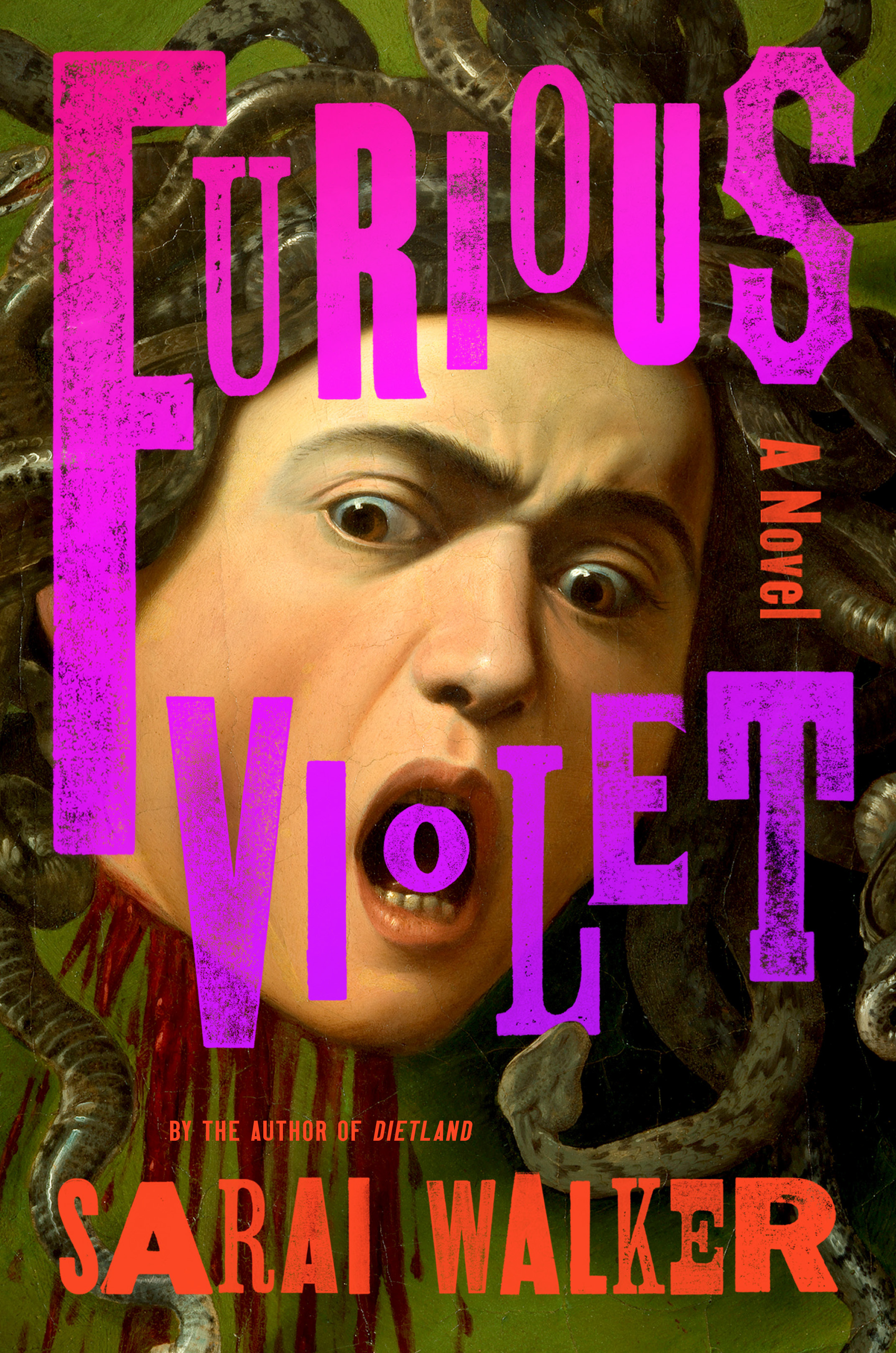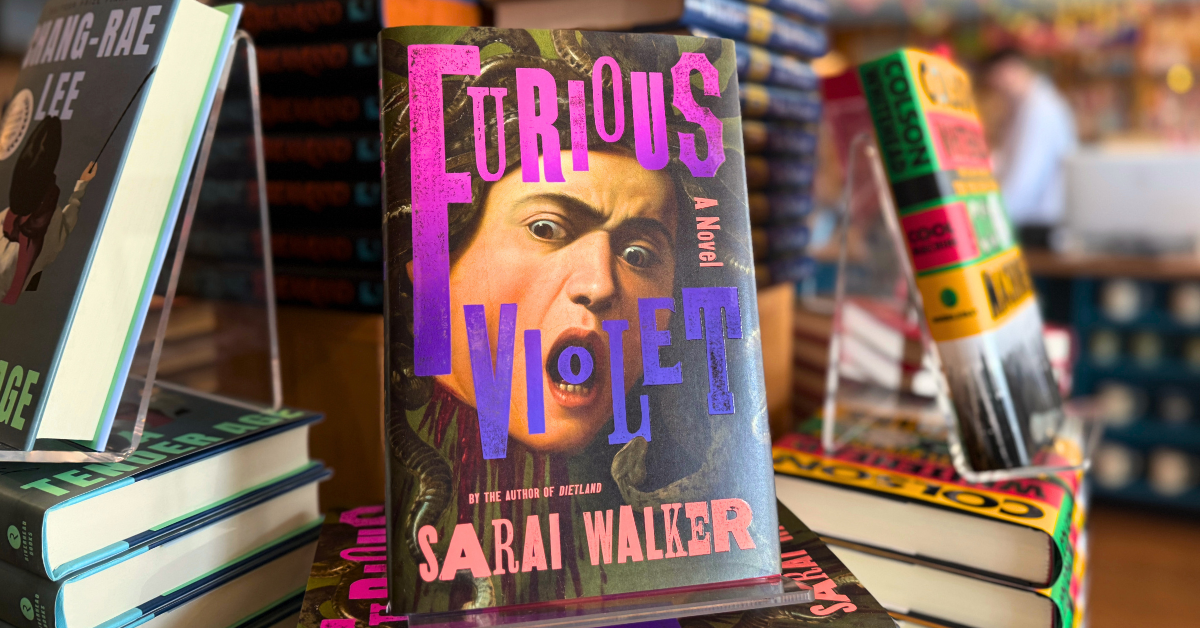
Furious Violet is the latest book by Sarai Walker. Enjoy this interview with bookseller Kim Baldwin and Walker as they chat about writing plus-size characters, Sylvia Plath, fandom, crones and more. Here’s Kim!
***
Getting to interview Sarai Walker is a dream come true. Dietland is a desert island book for me, so I was thrilled when her latest, Furious Violet, came out. As you can tell by the Caravaggio cover, Walker is not messing around. In this book we meet West, a 49 year old, plus-sized, true crime writer driving around in a Kia Surrender, drinking a Big Gulp Mountain Dew. She’s unapologetically fat, unapologetically Gen X and unapologetically pissed off. My own personal Holy Trinity.
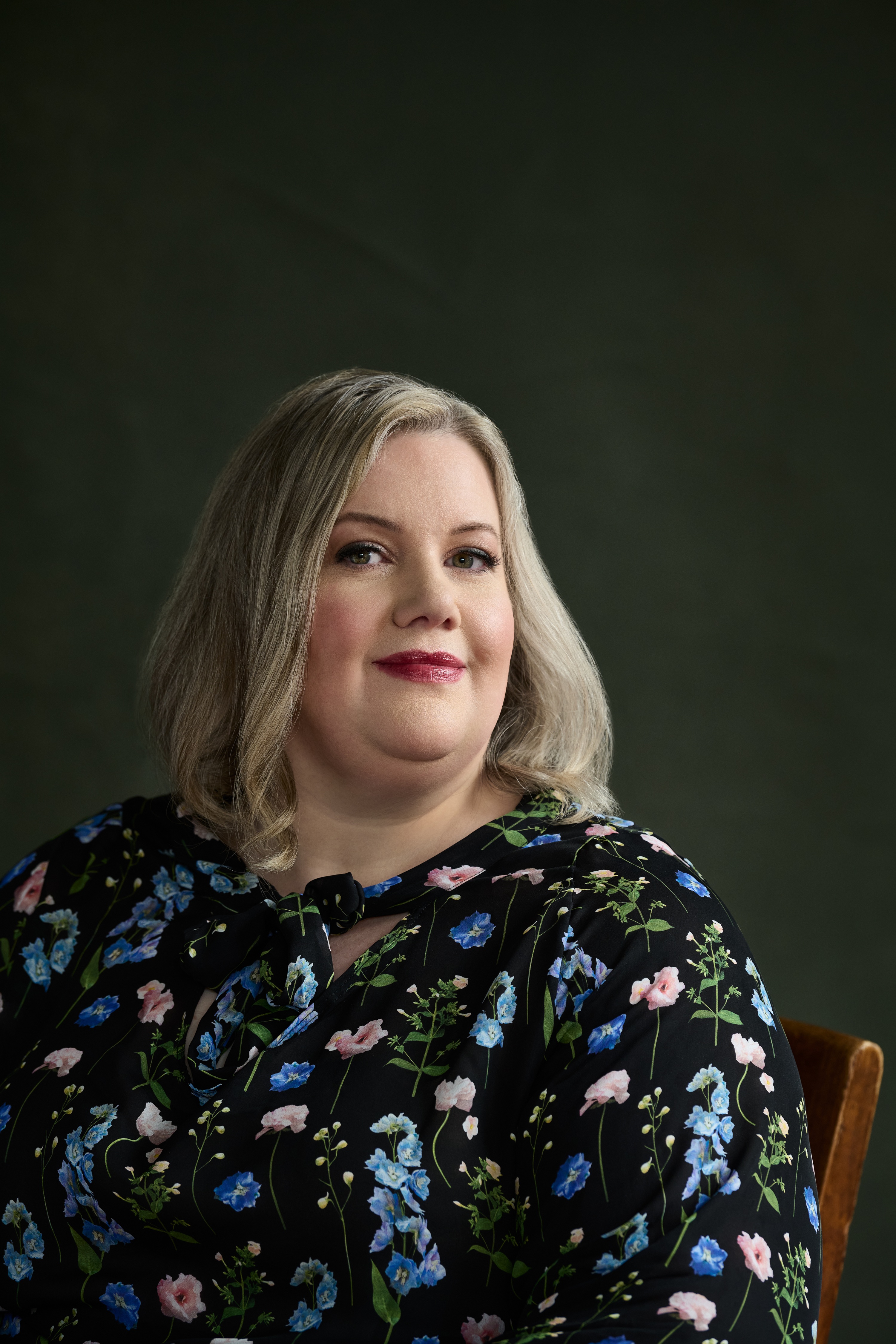
Kim Baldwin: It’s refreshing to meet a fat main character who doesn’t apologize for her appetite or what she eats. The Big Gulp Mountain Dews, gas station snacks and fast food are fun details. I love the scene in the restaurant where West orders a plate of buffalo wings and a platter of ribs, fries and coleslaw. Did you enjoy writing about the food West eats?
Sarai Walker: I absolutely loved it. Since I’m mostly known for my first novel, Dietland, which explores fat embodiment, and since I’m fat myself, there’s an expectation that I will write about fat bodies in my books. As such, it’s something I always have to carefully consider when writing. In Furious Violet, I rebel against these expectations and never outright say that West is fat (although she is called that by another character). I prefer that the reader imagines what she looks like for themselves. She eats a lot of trashy food and never apologizes for it or cares about her weight, whatever that might be. This was really liberating and fun to write. What’s interesting is that I had written a couple drafts of this novel before GLP-1 mania struck, and so I think West’s relationship with food might be even more subversive now in this current climate.
KB: You write believable and relatable characters. I love that West drives a Kia Surrender. I think in the same way so many of us saw ourselves in Plum in Dietland, many will see themselves in West. What’s harder for you, coming up with the characters, or coming up with the story? Does one come before the other?
SW: I don’t think story can exist without character—at least not for me. It’s important, though, to distinguish between premise and story. With the three novels I’ve written so far, I came up with a premise first. With Furious Violet, I knew I wanted to write a detective novel and I knew my main character would have a famous mother and there would be a stalker. With that in mind, I created a character and wrote about 60 pages, but I couldn’t get it to work, which was incredibly frustrating. I had to trash those chapters and start again. After a couple months, West finally appeared and began talking to me— voice is always my way into a story. As I wrote her into existence, she shaped the story and dictated what it would be about. So to answer your question, character is more difficult—it’s not easy to create a human being on the page.
KB: You’ve said that this book is inspired by Sylvia Plath, her fandom and the ways fans lay claim to women’s work. I was thinking about that when I read this sentence from West, “I was simply roadkill on the feminist literary criticism superhighway, a raccoon with its guts spattered all over the asphalt.” How did writing this book through West’s perspective, the perspective of the daughter of the famous writer, enable you to tell this story?
SW: I’ve been a Sylvia Plath fan for most of my adult life and she really fascinates me. I love her work, of course, and it’s been very influential to me as a writer. But I’m also really interested in the cult of celebrity surrounding her, and how she only became famous after her death. It’s this kind of posthumous celebrity that I wanted to explore and satirize in Furious Violet, and so the novel is narrated by the daughter of a Plath-inspired character named Juliet Bellwood. West has had to live under the shadow of her mother’s fame her entire life and it’s been a nightmare for her. The Plath influence in the novel is clear, but my characters are fictional, and so I had total freedom in telling this story—I could pull at the threads of obsession and rage I saw present in Plath’s legacy and do whatever I wanted with them. It was tremendous fun.
KB: You bring the Maiden, Mother, Crone archetype into this book. West, our protagonist, is 49, having a hell of a time with her erratic periods and due to a tubal ligation when she was younger, has never had kids. She is moving from “Mother” to “Crone.” You and I are both crones. How do you feel about becoming a crone?
SW: Luckily for us, being a crone is all the rage these days! For me it’s been a roller coaster. Turning 50 was kind of fun, since it’s an iconic age and on some level it was a relief to just get it over with. But once I turned 51, and then 52, it began to hit me that I’m getting older, that most people on earth are younger than me, that time is moving extremely quickly. It can be scary and I wanted to write about that in my novel. On top of that, I haven’t really felt like myself in recent years thanks to perimenopause. I’m not the fiery, passionate woman who wrote Dietland—I definitely feel more muted nowadays, which is very strange for me, but older friends tell me this will change over time. I had worried this might negatively affect Furious Violet when I was writing it, but it’s received the best reviews of all my books so far. I am hopeful this new phase of my life will continue to be creatively fruitful.
KB: The dedication in this book reads, “For the daughter I never had.” In the book, West shares with her therapist how she felt “edged out” when the women in her friend group had babies and disappeared into their lives as mothers. This is something that is hard to talk about without hurting anyone’s feelings, but there is real grief there. Have you dealt with this in your own life? Was it important for you to include this in West’s story?
SW: I don’t have kids, and this isn’t a sensitive or difficult topic for me, although I know it can be for other women and it’s important to be sensitive to that. What’s difficult for me is being treated as less than fully human because I don’t have children, which is something I explore in the novel. As a society, we tend to equate being a parent with positive moral characteristics. There’s this idea that having children makes a person more loving and caring and empathetic, even though some of the worst people in America have children, the very same people starting wars, taking away food stamps and health insurance, and putting immigrant children in prison camps. I would prefer that we judge people by their actions, not by whether they’ve reproduced, which really tells us nothing about who a person is at their core.
KB: Let’s talk about Michelle McNamara. You included the epigraph, “There’s a scream permanently lodged in my throat now” from Michelle’s book I’ll Be Gone in the Dark. In your author’s note you mention how influential that book was to you. How did Michelle and/or her work influence Furious Violet?
SW: Earlier in our conversation, I mentioned that I struggled at first to develop my main character. When I’m stuck with writing, I usually turn to reading to inspire and guide me. So when I was struggling with Furious Violet, I read I’ll Be Gone in the Dark, followed by Truman Capote’s In Cold Blood, not realizing at the time how these two books, chosen at random from my TBR pile, would influence my novel. I’ve always been interested in true crime, and reading these two books—especially McNamara’s—helped me see that West should be a crime writer. The fictional serial killer in my novel, the Crying Killer, is inspired by her writing about the Golden State Killer. She was such a wonderful writer, and because of her untimely death, we were robbed of the other amazing books she could have written.
KB: I was thrilled to see references to Miss Marple, Midsomer Murders and Murder, She Wrote. Are you a big cozy mysteries person? Are you watching (or reading) any that you want to shout-out?
SW: I’m a sucker for a TV show about a murder in a cute village. Everybody knows the Cabot Cove episodes are the best episodes of Murder, She Wrote. I also love British mystery shows and have been watching them on PBS since the 1990s, including Poirot, Marple, Midsomer Murders, Lewis, Vera, Dalgleish and so on. For whatever reason, Americans just can’t make shows like this. Our shows are grittier. The last really great HBO detective show I watched was Task with Mark Ruffalo—there was not an ounce of quaintness to be found, but it was fantastic. I also thought Scarpetta was quirky and entertaining. Furious Violet is definitely not the cozy type of mystery, but I loved referencing those kinds of iconic stories, since they certainly influence our views on crime.
KB: Thank you so much for taking time to answer my questions, Sarai! To wrap it up, we always like to end with this question: What is your favorite thing about independent bookstores?
SW: There are a lot of things I could say, but I’m going to focus on my own pleasure. Independent bookstores have really saved my sanity over the years. I have a tendency to lock myself away and write and not leave the house for long stretches. Then all of a sudden I’ll become stir crazy, and I know a trip to my local indie will restore me. I’ll spend a couple hours browsing books in a serene environment, and leave with not only books but cute cards and stickers and little gifts. I’ll usually end my afternoon with a pastry and an iced coffee nearby. This is my idea of heaven.
Furious Violet is on our shelves now!