
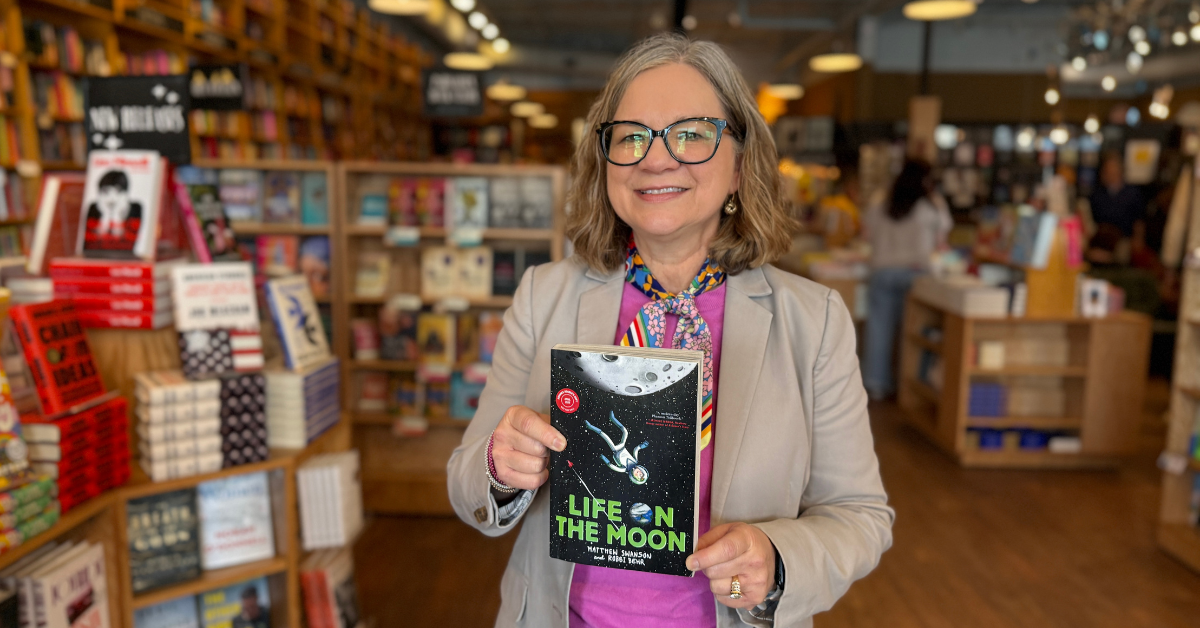
Life on the Moon by Matthew Swanson and Robbi Behr is the Spark Book Club pick for April. The Spark selection committee picked this book for our middle grade subscribers because it is a multi-layered adventure story, both in text and illustrations. Thank you to Matthew and Robbi for this interview!
— Rae Ann Parker, Director of Books and Events for Young Readers
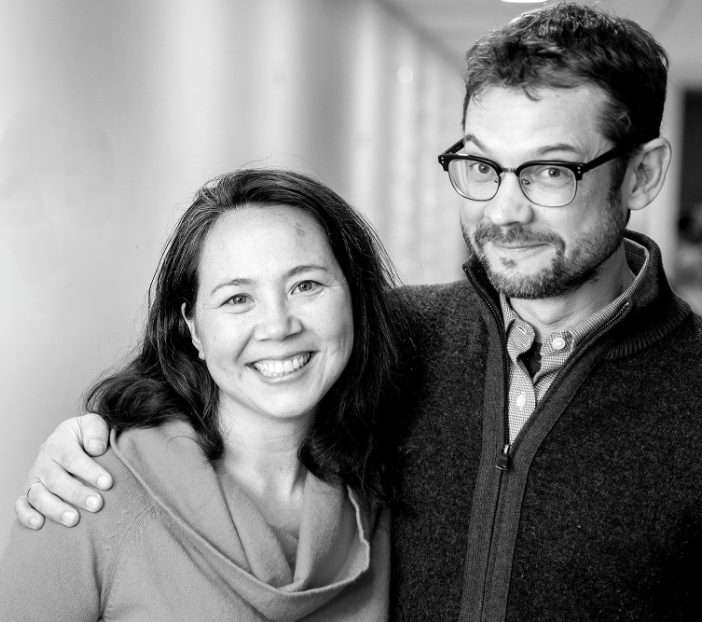
RAP: Hi Robbi and Matthew! First of all, our entire Spark Book Club committee loved Life on the Moon. Thank you for making this book together. How did the spark of this book happen?
Matthew: Oh boy. Should I make something up or tell the truth?
Robbi: Tell the truth! Matthew makes up stories for a living, but he’s a terrible liar.
M: The truth is, I have no idea what sparked this book. It might have been something I ate.
R: Matthew’s brain is a big, mysterious soup. Nobody knows what’s going on inside there, even Matthew.
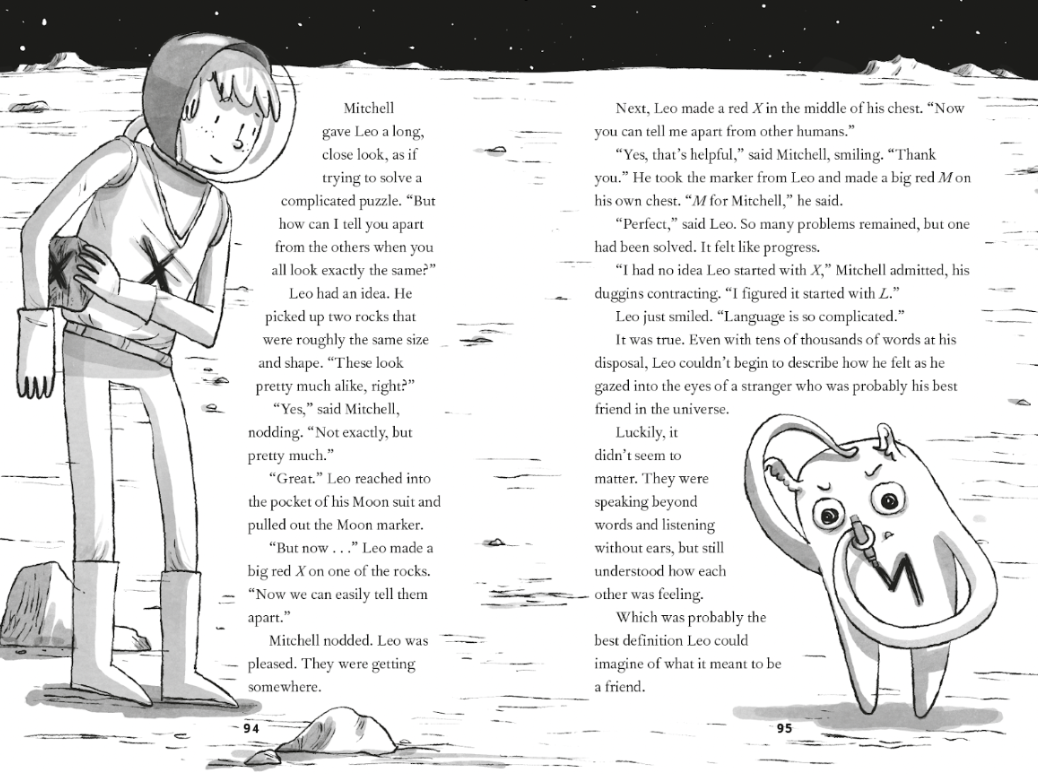
M: Especially Matthew. I mean, I remember when I started writing Life On the Moon. I was sitting in our bed. It was May. I wrote a conversation between a boy and a moon creature. And I was taken by the misunderstandings that arose from the fact that they came from completely different worlds. And I found the moon creature very charming.
R: He is charming.
M: I wanted to spend more time with him!
R: Matthew is basically just trying to make friends when he writes books.
M: Funny you should say that, because the charming moon creature is my favorite thing about Life On the Moon. I sincerely believe that Mitchell the Valrooten is the ideal friend. I worry that kids will read this book and be sad that they will never find a friend as good as Mitchell.
R: I know. It stinks.
M: Anyway, that conversation was probably the spark.
RAP: When you’re working on your books, do you brainstorm ideas together or toss out ideas separately?
R: For this book, just like every other book we make, Matthew writes the first draft and then shows it to me. And Matthew’s first drafts are always…
M: Choose your words carefully, Robbi!
R: I was going to say incomplete, just like every draft is. But part of what makes Matthew’s drafts especially incomplete is that he never really knows what he’s trying to say. My job is often to say, “Matthew, that’s so interesting what you’re saying about colonialism.” And he’s like, “Oh, I didn’t even realize I was writing about colonialism.”
RAP: When your character Leo Brightstar arrives on the moon, he knows the two rules:
The first rule of life on the moon is: There is no life on the moon.
The second rule is: Don’t ask questions.
From there, you take the reader on an unexpected journey about life on the moon that echoes so many things about life on Earth. What is your favorite thing about Leo and his journey in the book?
M: I mean, I should be honest. Leo is in many ways me, just as any character that I write is in many ways me. And in this particular book, Leo is the part of me that is wrestling with his parents’ divorce, wrestling with a lot of confusion and insecurity that comes from feeling profoundly displaced. He goes to the moon hoping to find a fresh start and a chance to figure out who he is. But he’s immediately cast into a place of uncertainty and discovery. And the thing that I love most about Leo…
R: Dude, you are making this book sound like a major bummer.
M: No, no, no. This is a very funny book. It’s hilarious.
R: Maybe talk about that!
M: The thing I love most about Leo is that he’s open to having his mind changed. He goes into his adventures on the moon with a very strong set of understandings and beliefs. And by the end, he believes pretty much the opposite. Not because he’s especially enlightened, but because circumstances force him to see the ways in which he was either wrong or not seeing the full picture.
R: But it’s not just a matter of circumstances. Leo’s transformation is possible because he’s forced to see things through the eyes of others he cares about—it’s what really spurs him to change.
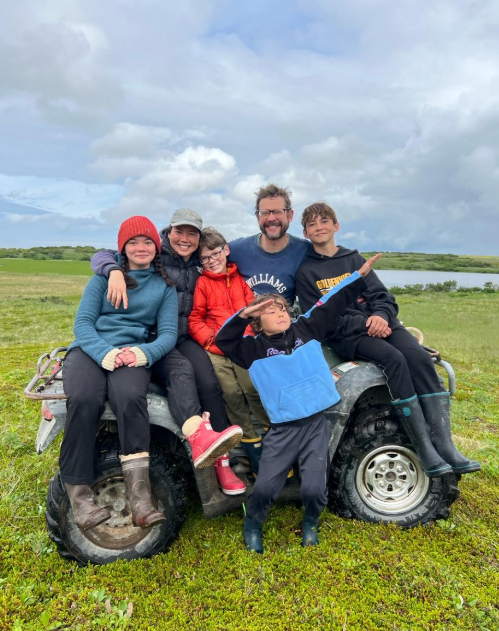
RAP: You spend your summers in Alaska running a commercial salmon fishing operation while living in a cabin with no electricity. I don’t know any other authors and illustrators for young readers with this as a second job. What’s your favorite thing about your summers?
R: My favorite thing about our summer adventures is that going to our part of Alaska is in many ways like going to the moon. I mean, we have no phone or internet. We cook with water that drains off the roof. We have a radio that only plays one station. We have a job that needs to be done, and all of our energy is focused on that job.
M: My favorite thing is sleeping in Alaska. We live in Maryland where it’s muggy, muggy hot in the summer, and up in Alaska we have 45-degree nights, and we sleep with the windows open. We’re so tired from fishing for 12 hours straight that we sleep like the blessed dead. It is my favorite thing. And honestly, one of my favorite things is watching our kids grow up in Alaska and the experiences they have. They’re stepping away from the internet for five weeks and exploring this world that’s completely beyond the frontiers of anything that we live back home. We get this rare opportunity to take our children to the moon every summer, and I think they have benefited greatly from it.
RAP: Do you write and draw a lot while you’re in Alaska?
R: I don’t! Every year, I think I’m going to do some drawing while we’re in Alaska, and I never do because I’m so focused on catching fish and not losing a finger or an arm. But Matthew still finds plenty of time to write.
M: It’s true. In fact, I wrote the first terrible draft of Life On the Moon in Alaska. We’d just built our new cabin. We didn’t even have a bed frame yet, so I sat on our mattress on the floor, leaning against the wall, writing away. It was that incredibly free initial flush of writing where there’s no such thing as a wrong answer because the parameters haven’t been established yet and anything goes.
RAP: Do you have any advice for young readers who want to make books one day?
M: Be persistent.
R: Yes. Just do it.
M: But don’t just do it for a minute. Do it for forty years. Robbi and I both knew early on that we enjoyed making stuff. And we just never stopped making things. We spent about ten years self-publishing weird little books that nobody wanted to buy because we loved doing it. We made about sixty books over about ten years, and we learned a lot, and we kept getting better, because we just kept making books, kind of insanely. You might have to be kind of insane to be an author or illustrator.
R: “Be insane” is not good advice for children who want to write.
M: All right, then. Give some good advice.
R: I would say enjoy yourself. Write. Draw. Create what you want. And do it persistently.
M: You’re only going to make books if you actually make books.
R: But here’s a big secret. Get a few pieces of paper and a stapler, write some words, draw some pictures, and you can have a book this afternoon.
M: That’s true. That’s the best thing about self-publishing.
R: You don’t need anyone’s permission to make your book. You can just make it. Suddenly, I am full of advice.
RAP: We ask everyone, what is your favorite thing about independent bookstores?
M: For me, it’s how they smell. And that there are often friendly animals wandering around. And that they sometimes have precarious and dangerous-seeming shelving that creates a great atmosphere. Like, something could happen at any moment. Whether it’s a book falling from a high shelf and crushing you or a cat looking at you sideways.
R: Matthew must have a very specific independent bookstore in mind.
M: I love the Midtown Scholar in Harrisburg, Pennsylvania. And I love the Tattered Cover in Denver. But my favorite is the Book Plate right here in our hometown of Chestertown, Maryland—which has rickety handmade bookshelves and a cat. We have not yet had the pleasure of going to Parnassus Books.
R: No, we haven’t. We planned to visit during the year we lived in a school bus, but we couldn’t go to Nashville because there was an ice storm.
M: What do you like about independent bookstores, Robbi?
R: I like that they each have their own unique personality. No two are the same. They are built from the hearts and spirits of individuals and not a giant corporation that tells you what books to buy and where to put them. Every time you step into an independent bookstore, it’s like a beautiful discovery of someone’s inner spirit. Sometimes there are cats and teetering bookshelves, but sometimes there are very well-constructed bookshelves. It just depends on whose spirit you are entering into.
RAP: Thanks so much for answering my questions and creating Life on the Moon!
Life on the Moon hits shelves on April 14. It’s not too late to join Spark Book Club and receive the April box with an extra-special letter from Robbi and Matthew! Sign your young reader up now for a monthly first edition hardcover book (which is sometimes signed!), along with a letter from the author.

 Musing