
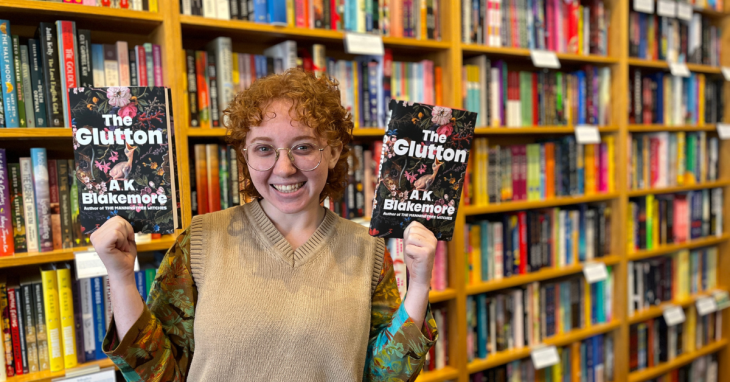
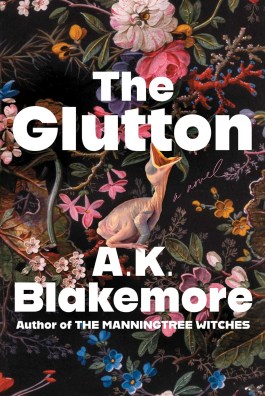
A.K. Blakemore returns to the literary scene with The Glutton, a poetic retelling of real life historical figure Tarare, the Glutton of Lyon. Blakemore walks the line between the beautiful and the grotesque expertly, depicting the full spectrum of the human spirit. I wept for Tarare. I felt his hunger as if it was my own, and I consumed his story so rapidly that it left me sick with sorrow. Getting to discuss the novel with A.K. was the metaphorical cherry on top to this perfect reading experience.
— Rachel Randolph, Parnassus bookseller

Rachel Randolph: What originally drew you to the history of The Glutton of Lyon? I’m curious if there was a particular moment when you connected to his character and knew you wanted to tell his story?
A.K. Blakemore: I first encountered him years and years ago – before I was even contemplating writing novels – during one of those late-night Wikipedia black holes that you get into when you’re in your early twenties and not great at sleeping. Or that I did, anyway? Beyond the obvious drama and intensity of his life, as it’s been presented to us, I suppose what most drew me to Tarare and his story was the dissonance I felt between the horrific and nightmarish qualities of his experience, and the light-hearted, almost comedic way he’s presented in the folk tradition, or pop culture (when he’s presented at all). The idea of being hungry all the time was one of the most terrifying, psychologically deleterious things I could imagine happening to a person – and yet he’s usually treated as a figure of fun. I suppose I wanted to approach him as a human. To deepen and complicate him as a historical figure, however I could, while staying as close as possible to what we know of his actual life as he lived it.
RR: Tarare is not your first historical character. Can you tell us what power lies in history as inspiration? How do you walk the line between truth and tale, and what sort of research goes into that?
AKB: Generally, I try to stay as close to the facts of the story I’m telling as possible – or as close to the ‘spirit’ of the facts as they are presented to us. Which is probably why so far I’ve been attracted to historical figures whose biographies are already made more vivid or strange by the context in which they were recorded – carnival performers, witch-hunters – figures variously othered, monstered, driven outside.
I try to do enough historical research to move comfortably through the world I’m trying to portray, but you can rely on that too much, I think. It’s still the imagination doing the heavy lifting, by necessity, when writing about characters about whom limited archival or documentary evidence exists. I usually spend more time with literature contemporaneous with the era I’m writing about than non-fiction about the era itself. It really helps me pin down the feel of the time, I think. To get a handle on the vocabulary, the texture, the contours (the vibe, essentially) that I need to go for.
RR: So many sentences had me fervently underlining so that I could return to them again later, and yet the story never dulled. It is as page-turning as it is beautiful. As a poet and novelist both, does one skill come more naturally? Is your rough draft story-focused with the poetic prose coming later, or the opposite?
AKB: The skills don’t really feel that different to me, in practice, actually? My first drafts are usually pretty complete, adorned, dressed in Sunday best etc. I find it easier to trim down than to elaborate in the later stages. Certainly with The Glutton, where I was trying to create a sense of appetite and sensuality and spontaneity that felt appropriate to Tarare and Tarare’s psychology, I sort of just threw myself into it, followed where the story (and Tarare) seemed to want to lead me.
I think, at the moment, anyway, I actually find writing prose probably easier. I’m quite a perfectionist when it comes to poetry, and working with such compressed space, as you are in a poem, it really feels more pressurised. Prose still feels like more of a place for play.
RR: Though the prose is beautiful, much of The Glutton is concerned with the disturbing and grotesque. As a society that upholds beauty, what meaning is there in the ugly? Can you speak to why it may be important to tell such ugly-seeming stories?
AKB: I think what we find ugly or repellent – and why – is a much more compelling question than what we find beautiful or appealing. I’ve been thinking a lot recently about questions of the grotesque, and what we mean when we say something is ‘grotesque’. The French literary critic and philosopher Bakhtin formulated a lot of interesting ideas around ‘grotesque literature’, and he thinks of it as literature that situates the human body within the natural world and portrays it as part of the natural world, rather than as separate, or somehow isolated from and ‘better than’ the natural world (I’m simplifying and paraphrasing here, obviously). So it’s the art of orifices and excretions and things that go out of the body and go into it – an art of rot and of decay. And obviously when we consider the horrible global consequences of mankind’s abuse of the natural world – an abuse borne partly from a sense of separation from and superiority to the natural world, reified through capitalism – the political significance of a ‘grotesque art’ that challenges these perceptions seems clear. The grotesque can also be a powerful form of ‘outsider art’, a way of taking ownership of what people find disgusting about you, or would use to other you. I’ve been recommending Lauren Elkin’s Art Monsters to everyone recently – it’s great on the uses of the grotesque in the feminist visual arts and feminist literature.
RR: Did you eat anything strange in preparation for writing the “insatiable man?” Was it difficult to come out of Tarare’s mindset after writing?
AKB: Absolutely not! Actually, kind of the opposite – I’ve been a vegetarian my whole adult life, and haven’t eaten meat in more than a decade now, so meat/flesh/blood already hold a certain level of sensory ick for me. Like, I find it very difficult to watch someone eating a steak, and the smell of frying bacon or a butchers’ shop make me feel a bit ill. So I suppose I did, to a certain extent, tap into that pre-existing aversion when I was writing the novel, and that was quite useful. I also did a lot of thinking about the taboos around food we still hold. It was interesting to me, how so little literature really centres our relationship to food and nourishment, when it structures all our lives so deeply.
RR: Before you published The Manningtree Witches, what writers did you look up to? What books make you think “I wish I wrote that”?
AKB: Some of my favourite contemporary writers are Claire Louise-Bennett (her Checkout 19 is, to my mind, the best novel published in the past five years), Gwendoline Riley and Fernanda Melchor. I also love Kafka, McCarthy and Nabokov. A lot of Russians. When I was writing The Glutton, I was deep in Emile Zola’s Les Rougon Macquart novels, and his sort of bathetic, effervescent theatrical-social-realism was a huge influence.
RR: And finally, as is tradition, I must ask: what is your favorite thing about independent bookstores?
AKB: The people who work there. Mainly wonderful stone-cold weirdos, in my experience.
The Glutton is on our shelves now! Grab a copy here.
 Musing