
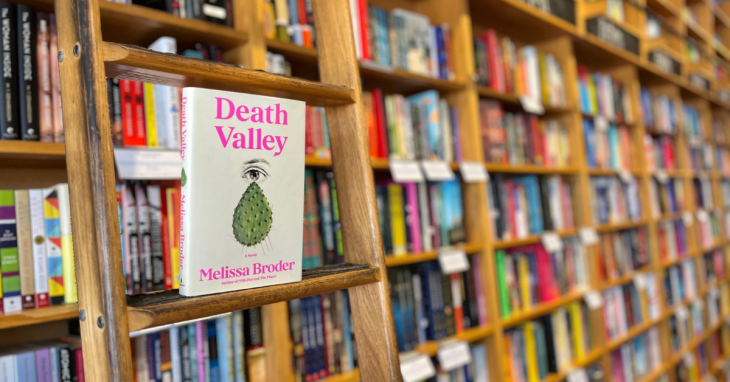
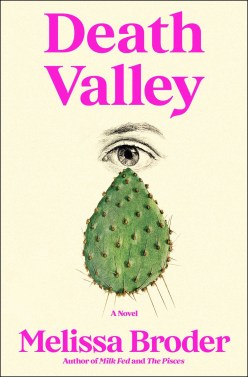
Is there any better feeling than being just a few chapters into a new book and already knowing that you’re about to read a story that is going to stick with you for years to come? Friends, if any book this year is going to give you that feeling, it’s Death Valley by Melissa Broder.
I’m unable to talk about Death Valley without a smile creeping onto my face. Even months after reading it, I’m still so easily brought back its all-consuming absurdity, surrealism, and depth. There was not a moment I spent reading this book when I knew what was coming next. Melissa Broder has outdone herself with this one. I am so excited for more of you to read Death Valley this fall, and I am thrilled I had the chance to pick Melissa’s brain about this book.
— Maddie Grimes, Parnassus bookseller
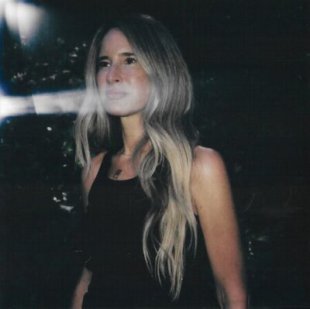
Maddie Grimes: You’ve managed to craft a story that is so wonderfully whimsical and uniquely entertaining despite it centering around some seriously somber and painful themes. This was my experience with Death Valley as a reader, but I’m curious how you experienced the novel while writing it? Were you also experiencing this mix of whimsy and pain during the drafting process?
Melissa Broder: I knew that I wanted to write a funny book about grief rather than a grief-y book about grief. My friend, the writer Susan Cheever, says that you can always tell when a writer is having a good time writing a book, and that it makes it more enjoyable. She said this of Thackeray’s Vanity Fair, but I believe it to be true of so many novels.
During the writing process I was relieved from grieving my father—drawn away from rumination and pain into a different part of my brain that made me feel like we still had some time left together, some forward propulsion, so long as I was still writing the book. It was the times when I wasn’t writing that were harder for me. And after.
MG: The premise alone for Death Valley is so striking. How long did it take you to have the bare-bones concept for the novel fully solidified in your mind?
MB: The magic cactus came to me right away—a gift of an image—as did the desert setting. I was literally driving in the desert when the first line of the novel came to me. The lost in the desert element came much later, on a different desert trip, when I briefly got lost on a hike, panicked, and injured myself getting back to the car. Once I’d stop crying, I celebrated. Now I knew what had to happen in my novel.
MG: One of the many things that adds to the reading experience of Death Valley is how meta of a story it is. How much of yourself did you put into your main character, and how much of this book would you say is autobiographical?
MB: The book begins as a mix of autofiction and fiction. My father was in the ICU for six months before he died. He did have a mustache. My husband has been sick for many years (twice as long as the narrator’s husband) with a progressive immune disease. I do push him around supermarkets in his wheelchair and I have knocked him into cracker displays. He does stand up from his wheelchair in public and I do shout, “It’s a miracle!” And I, too, love a Best Western and get panic attacks from Red Bull.
From there, the novel departs into pure fiction. I’ve never been inside a magic saguaro cactus. I’ve talked to rocks, but they’ve never spoken back. I’ve never pissed off a tribe of teen bunnies, and I’ve never ridden on top of a bird named Mustache Oriole. I’ve never ridden any bird.
MG: A large part of Death Valley is the main character embarking on a classic, archetypal “man-vs-nature” journey. Do you have any favorite man-vs-nature stories from literature or film that inspired this part of your novel?
MB: I read Edward Abbey’s Desert Solitaire four times while writing the novel. The Passion According to G.H. by Clarice Lispector was an influence, though that is more of a woman vs. the void story. Generally, I love the journals of May Sarton and she’s constantly having skirmishes with the elements—particularly red squirrels that invade her home and anything that attacks her garden.
MG: A lot of readers see you as one of the spearheads of the increasingly popular weird-and-unhinged women’s-fiction subgenre. Do you feel any pressure as an author to out-weird your previous books? Or do you feel empowered to know that you are encouraged to push boundaries and break the lit-fic mold?
MB: I don’t feel any pressure to out-weird. I think the weird comes naturally. I get these images—the merman, the magic cactus—that make so much sense to me on an archetypal level. Sometimes, if I tell a writer friend my idea at the beginning phase of writing a novel, I’ll get a blank look. Recently, I was talking to my friend Ryan O’Connell, who writes for television and is very good at structure, about a germ I had for a novel involving an old woman riding a younger man around a supermarket with a floor covered in baked beans. He was like: “What’s the plot?” I was like, “That’ll come. But baked beans!”
As for the unhinged part, that also comes naturally. I never think of my characters as “unlikeable protagonists,” though I hear that said of my work. But I like my protagonists very much.
MG: As always, we like to end on this question: what is your favorite thing about independent
bookstores?
MB: The potentiality! Walking into an independent bookstore feels like hope. It’s a buffet of mysterious paper rooms (not to mix metaphors). It’s an hour that will then become many days and universes. Also, as an author, there is no greater thrill than walking into a bookstore and seeing your book in there. None! It will never get old.
Death Valley is on our shelves now!
 Musing